
Intel Xeon 600 AI Workstation CPUs: A Shift Toward AI-Native Compute
Intel Xeon 600 AI Workstation CPUs mark a shift toward AI-native workstation computing, combining traditional CPU architecture with built-in acceleration for machine learning workloads.
Intel Xeon 600 AI Workstation CPUs: A Shift Toward AI-Native Compute — तकनीक / समाचारसेतु
Introduction
The Intel Xeon 600 Series Processor represents a decisive architectural move toward AI-native computing in enterprise and workstation environments. Rather than focusing solely on traditional server throughput, this processor line is engineered to sustain large-scale inference pipelines, memory-intensive analytics, and heterogeneous accelerator workloads. It targets organizations operating large datasets, machine-learning inference services, and compute-dense virtualization clusters.
The Intel Xeon 600 Series Processor represents a decisive architectural move toward AI-native computing in enterprise and workstation environments. Rather than focusing solely on traditional server throughput, this processor line is engineered to sustain large-scale inference pipelines, memory-intensive analytics, and heterogeneous accelerator workloads. It targets organizations operating large datasets, machine-learning inference services, and compute-dense virtualization clusters.
Architecture and Core Design
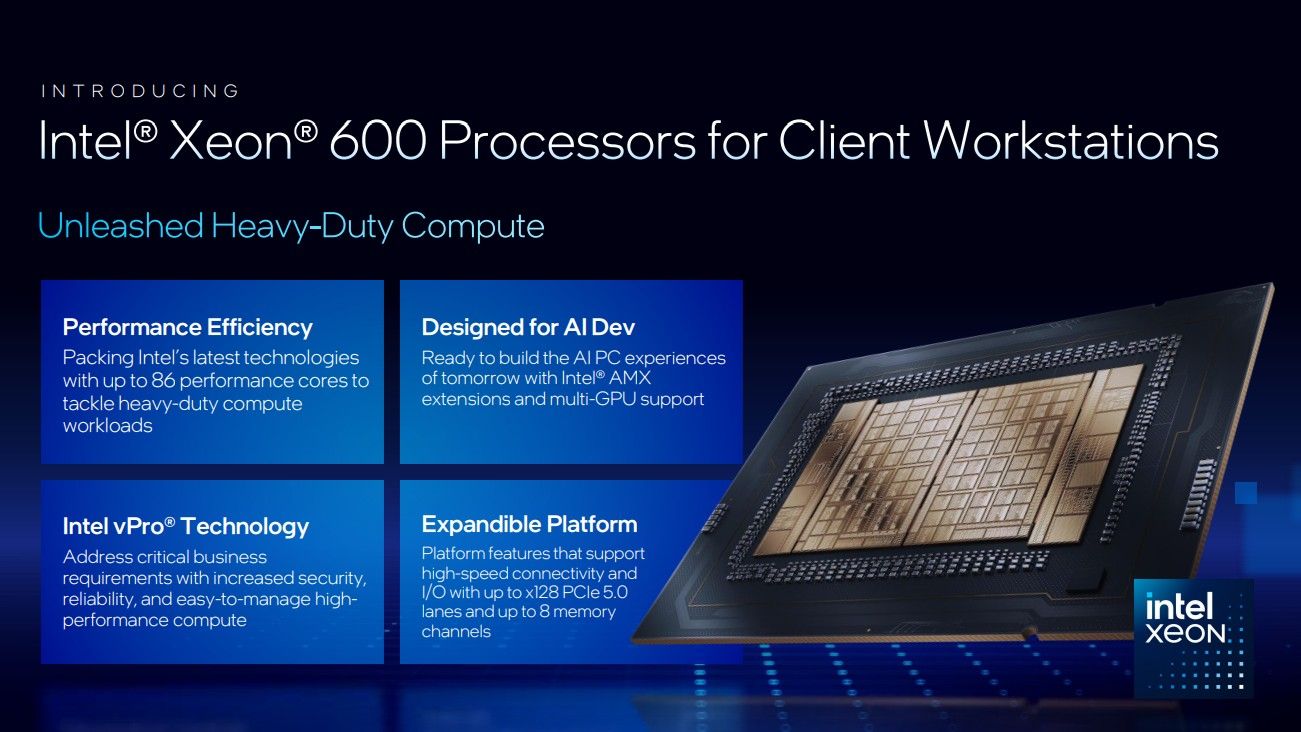
The Xeon 600 family adopts a high-density multi-core architecture, scaling up to 86 cores with a focus on parallel execution efficiency. Each core is optimized for sustained throughput under multi-threaded workloads such as:
-
real-time inference processing
-
distributed database queries
-
containerized microservices
The architecture integrates advanced instruction pipelines and expanded cache hierarchies, allowing the processor to sustain heavy memory-bound workloads without the latency penalties common in earlier server generations.
“The Intel Xeon 600 Series Processor represents a decisive architectural move toward AI-native computing in enterprise and workstation environments.”
A key engineering focus lies in balancing compute density and thermal efficiency, enabling dense deployments inside modern rack-scale data-center environments.
The Xeon 600 family adopts a high-density multi-core architecture, scaling up to 86 cores with a focus on parallel execution efficiency. Each core is optimized for sustained throughput under multi-threaded workloads such as:
- real-time inference processing
- distributed database queries
- containerized microservices
The architecture integrates advanced instruction pipelines and expanded cache hierarchies, allowing the processor to sustain heavy memory-bound workloads without the latency penalties common in earlier server generations.
“The Intel Xeon 600 Series Processor represents a decisive architectural move toward AI-native computing in enterprise and workstation environments.”
A key engineering focus lies in balancing compute density and thermal efficiency, enabling dense deployments inside modern rack-scale data-center environments.
Memory Subsystem and Bandwidth
AI and analytics workloads are frequently constrained by memory bandwidth rather than raw compute power. The Xeon 600 platform addresses this through an expanded memory architecture capable of supporting up to 4 TB of ECC-protected memory.
Key characteristics include:
-
large-capacity DDR memory channels for high bandwidth
-
error-correcting memory for mission-critical reliability
-
optimized latency pathways for database and AI workloads
This memory subsystem allows the processor to manage massive in-memory datasets, a common requirement in financial analytics, recommendation engines, and enterprise AI pipelines.
AI and analytics workloads are frequently constrained by memory bandwidth rather than raw compute power. The Xeon 600 platform addresses this through an expanded memory architecture capable of supporting up to 4 TB of ECC-protected memory.
Key characteristics include:
- large-capacity DDR memory channels for high bandwidth
- error-correcting memory for mission-critical reliability
- optimized latency pathways for database and AI workloads
This memory subsystem allows the processor to manage massive in-memory datasets, a common requirement in financial analytics, recommendation engines, and enterprise AI pipelines.
High-Speed I/O and Accelerator Integration
Modern AI workloads rarely operate on CPU compute alone. They rely heavily on GPUs, AI accelerators, and high-speed storage systems. The Xeon 600 architecture addresses this with 128 PCIe 5.0 lanes, enabling extremely high-bandwidth connectivity.
This design allows systems to attach:
-
multiple AI accelerator GPUs
-
NVMe storage arrays
-
high-performance network interfaces
The result is a platform capable of functioning as a compute orchestration hub, coordinating multiple accelerators without creating bandwidth bottlenecks.
Modern AI workloads rarely operate on CPU compute alone. They rely heavily on GPUs, AI accelerators, and high-speed storage systems. The Xeon 600 architecture addresses this with 128 PCIe 5.0 lanes, enabling extremely high-bandwidth connectivity.
This design allows systems to attach:
- multiple AI accelerator GPUs
- NVMe storage arrays
- high-performance network interfaces
The result is a platform capable of functioning as a compute orchestration hub, coordinating multiple accelerators without creating bandwidth bottlenecks.
AI-Oriented Workload Optimization
Unlike earlier server processors designed primarily for virtualization and database hosting, the Xeon 600 line integrates AI-oriented execution enhancements.
These improvements support:
-
neural-network inference acceleration
-
large-scale recommendation systems
-
natural-language processing pipelines
-
real-time analytics engines
Such capabilities enable organizations to deploy AI inference services directly within CPU-based infrastructure, reducing reliance on specialized accelerator hardware for moderate workloads.
Unlike earlier server processors designed primarily for virtualization and database hosting, the Xeon 600 line integrates AI-oriented execution enhancements.
These improvements support:
- neural-network inference acceleration
- large-scale recommendation systems
- natural-language processing pipelines
- real-time analytics engines
Such capabilities enable organizations to deploy AI inference services directly within CPU-based infrastructure, reducing reliance on specialized accelerator hardware for moderate workloads.
Enterprise Deployment Scenarios
The Xeon 600 processor family is engineered for environments where scalability, reliability, and sustained compute throughput are essential.
Typical deployment scenarios include:
1. Cloud infrastructure nodes
Handling containerized services, virtual machines, and microservices at hyperscale.
2. AI inference clusters
Running recommendation engines, fraud detection systems, and intelligent search platforms.
3. Enterprise data analytics platforms
Processing high-volume transactional and analytical datasets in real time.
4. Hybrid compute environments
Operating alongside GPUs or specialized accelerators in heterogeneous computing architectures.
The Xeon 600 processor family is engineered for environments where scalability, reliability, and sustained compute throughput are essential.
Typical deployment scenarios include:
1. Cloud infrastructure nodes
Handling containerized services, virtual machines, and microservices at hyperscale.
2. AI inference clusters
Running recommendation engines, fraud detection systems, and intelligent search platforms.
3. Enterprise data analytics platforms
Processing high-volume transactional and analytical datasets in real time.
4. Hybrid compute environments
Operating alongside GPUs or specialized accelerators in heterogeneous computing architectures.
Strategic Importance in the AI Infrastructure Race
Global demand for AI computation has triggered an intense competition among semiconductor vendors. With the Xeon 600 platform, Intel is positioning itself to compete directly in the rapidly expanding AI infrastructure market.
Rather than targeting consumer computing, this processor line addresses the core computational layer of modern AI systems, where performance, reliability, and scalability determine the feasibility of large-scale machine-learning deployment.
Global demand for AI computation has triggered an intense competition among semiconductor vendors. With the Xeon 600 platform, Intel is positioning itself to compete directly in the rapidly expanding AI infrastructure market.
Rather than targeting consumer computing, this processor line addresses the core computational layer of modern AI systems, where performance, reliability, and scalability determine the feasibility of large-scale machine-learning deployment.
Conclusion
The Intel Xeon 600 processor series represent more than a routine server upgrade. It reflects a broader transformation in computing infrastructure where AI processing, high-bandwidth memory access, and accelerator integration form the foundation of enterprise data centers.
As organizations increasingly depend on AI-driven decision systems and real-time analytics platforms, processors like the Xeon 600 will serve as the computational backbone enabling these technologies to operate at scale.
The Intel Xeon 600 processor series represent more than a routine server upgrade. It reflects a broader transformation in computing infrastructure where AI processing, high-bandwidth memory access, and accelerator integration form the foundation of enterprise data centers.
As organizations increasingly depend on AI-driven decision systems and real-time analytics platforms, processors like the Xeon 600 will serve as the computational backbone enabling these technologies to operate at scale.